AI adoption is becoming a bottom-up movement
The first phase of enterprise AI was pushed from the top. The next phase will be pulled from the bottom, by people who understand the work and can see where AI genuinely helps.
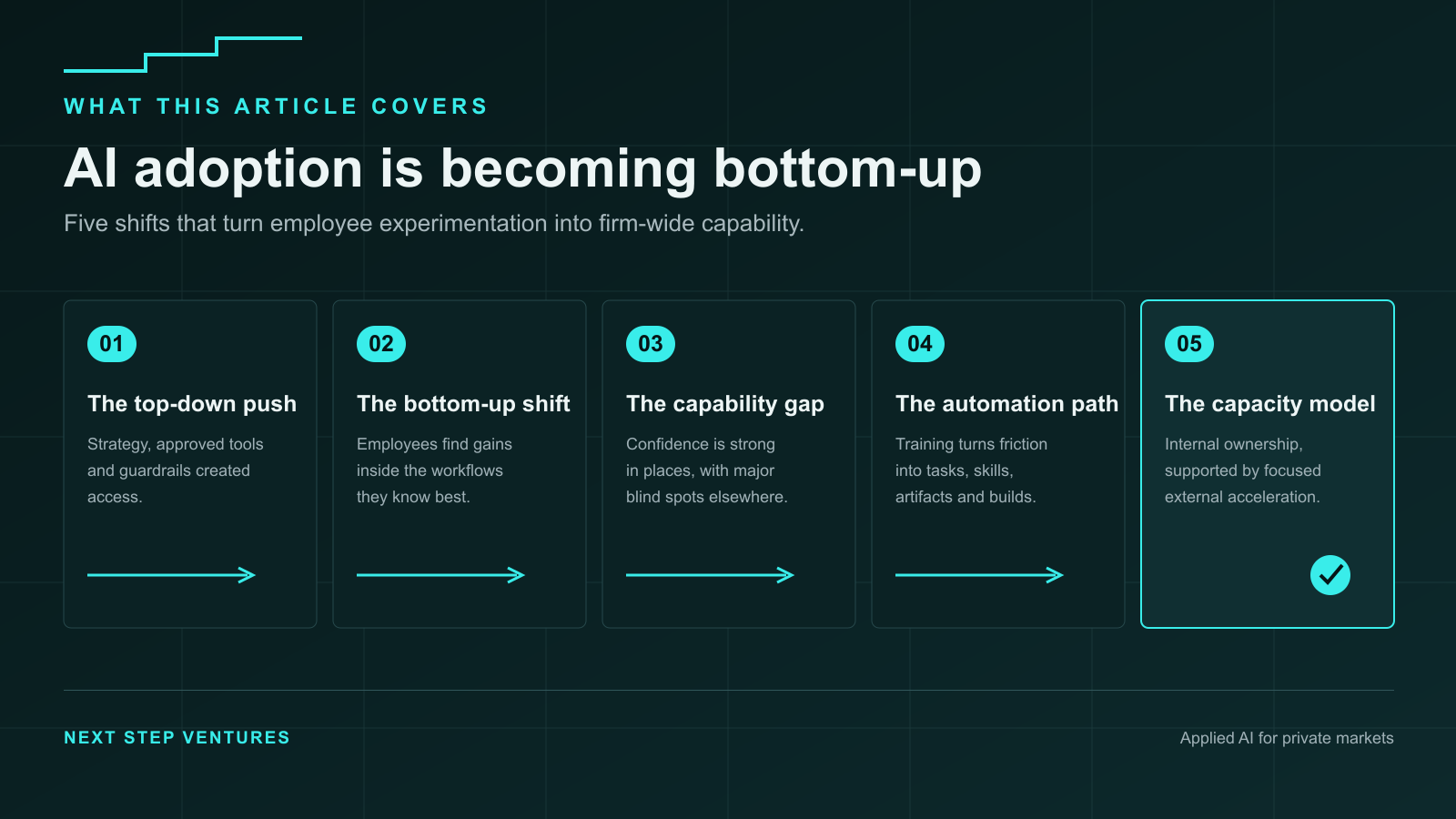
The top-down push did its job
Most firms began their AI journey in a sensible way.
Leadership decided that AI mattered. The firm selected approved tools, created policies, formed a working group and started asking for use cases. Without that top-down push, many employees would still not have access to enterprise AI at all.
Private-markets firms are also increasing their ambition. KPMG's 2026 survey of large US asset-management and private-equity organisations found that 78% expected AI to remain a top investment priority, while 68% were piloting AI agents and 24% were already deploying them.
So the strategic direction is there. The tools are arriving. In some firms, dedicated AI or automation teams are already producing useful internal solutions.
But access is only the first step.
Giving somebody an AI tool does not automatically show them how to apply it across the work they know best.
The movement is becoming bottom-up
Employees are now experimenting for themselves.
They are using AI to draft, summarise, research, analyse and prepare work. They know where the repetitive steps are. They know which documents take too long to review. They know where information gets stuck and which outputs are repeatedly sent back for correction.
That knowledge is incredibly valuable because the best use cases are rarely invented in an AI strategy meeting. They are normally found inside the work.
BCG's global 2026 AI at Work research found that 74% of frontline employees were regular AI users. Among regular frontline users, 42% said they were saving at least eight hours a week.
This was not a private-markets-only study, but the direction is relevant. Adoption is no longer dependent on a small innovation team persuading everybody else to try the technology. Employees are already using it and discovering value from the bottom up.
The opportunity now is to make those gains more consistent, more transferable and more valuable to the firm.
People know their jobs. They do not necessarily know the whole tool
This is where a strange capability gap is forming.
An employee may be very good at using AI for one part of their role and completely unaware that another useful capability exists.
Someone might be confident summarising documents but not know how to compare a folder of material inside a persistent project. Another person may produce strong research but have never used structured instructions, reusable skills, data analysis or connectors. A team might repeatedly use the same prompt without realising it could become a consistent artifact or lightweight automation.
That does not mean they are poor AI users. It means their knowledge has developed through necessity rather than through a proper foundation.
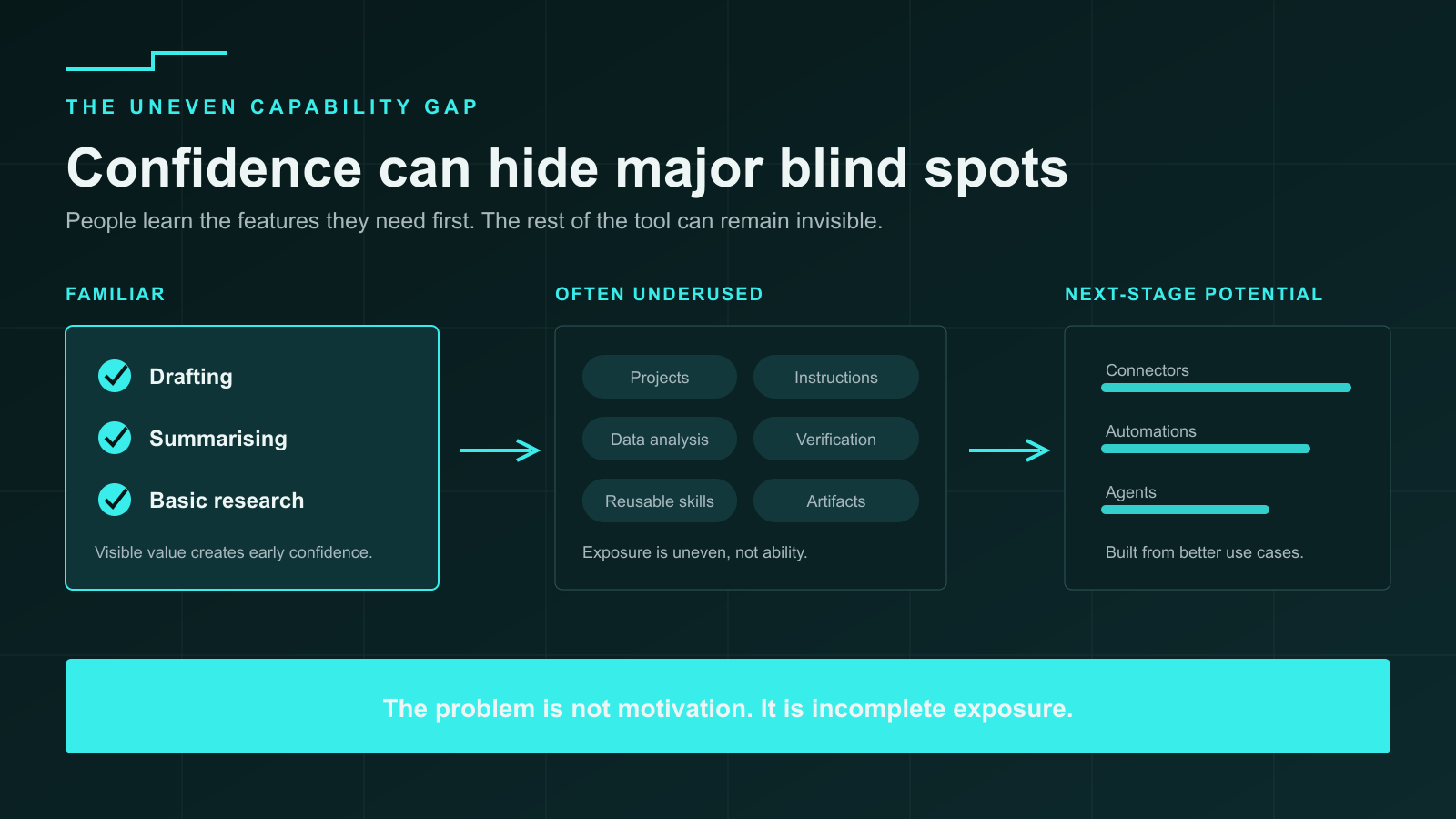
In private markets, this matters because the work is varied and judgement-heavy. Investment, portfolio, operations, investor relations, finance, legal and compliance teams all see different opportunities. A generic prompt demonstration will not connect those opportunities into a useful operating model.
MSCI's 2026 survey of 130 general partners found that advanced data, technology and AI capabilities were the biggest capability gap, cited by 48% of GPs and 63% of mid-sized firms.
People need enough breadth to recognise what is possible, then enough role-specific practice to apply it safely to their own workflows.
Foundational training creates an automation pipeline
The purpose of foundational AI training for private markets is not to turn every employee into a technical specialist.
It is to create a common floor.
People should understand the main ways of working with AI, how to structure instructions, how to use documents and data, how to verify an answer, what must remain under human review and when a repeated task could become something reusable.
Once that foundation exists, use-case generation becomes much better.
Instead of suggesting broad ideas such as "use AI for reporting", employees can describe a specific workflow, the data it uses, the judgement it requires and the output that good work should produce. A focused 30-minute AI working session can then decide whether the opportunity should become a task, skill, artifact, lightweight automation or larger implementation project.
This is how training starts to spin out automation. Not because every person begins building agents, but because more people can identify buildable opportunities and explain them properly.
Internal AI teams cannot be the delivery route for everything
Many larger firms now have a central AI, innovation or automation team. That is a good development. Those teams are important for architecture, governance, approved tooling, complex integrations and higher-risk builds.
The problem is capacity.
They quickly become surrounded by business-as-usual questions, project meetings, approvals and a growing queue of use cases. It is difficult for the same small team to own enterprise strategy, govern production systems, train every employee and facilitate detailed workflow discovery across every department.
This is where focused external support can be useful.
An external consultant can run a bounded piece of work: deliver the foundational sessions, facilitate departmental use-case workshops, help teams turn repeated tasks into reusable workflows and hand a structured pipeline back to the internal team.
The value is not that the external person replaces the firm's AI team. It is that they can create momentum without becoming interlaced with every internal process or existing project.
The internal team keeps ownership. The external support increases throughput.
The model needs both directions
Bottom-up adoption does not mean abandoning top-down strategy.
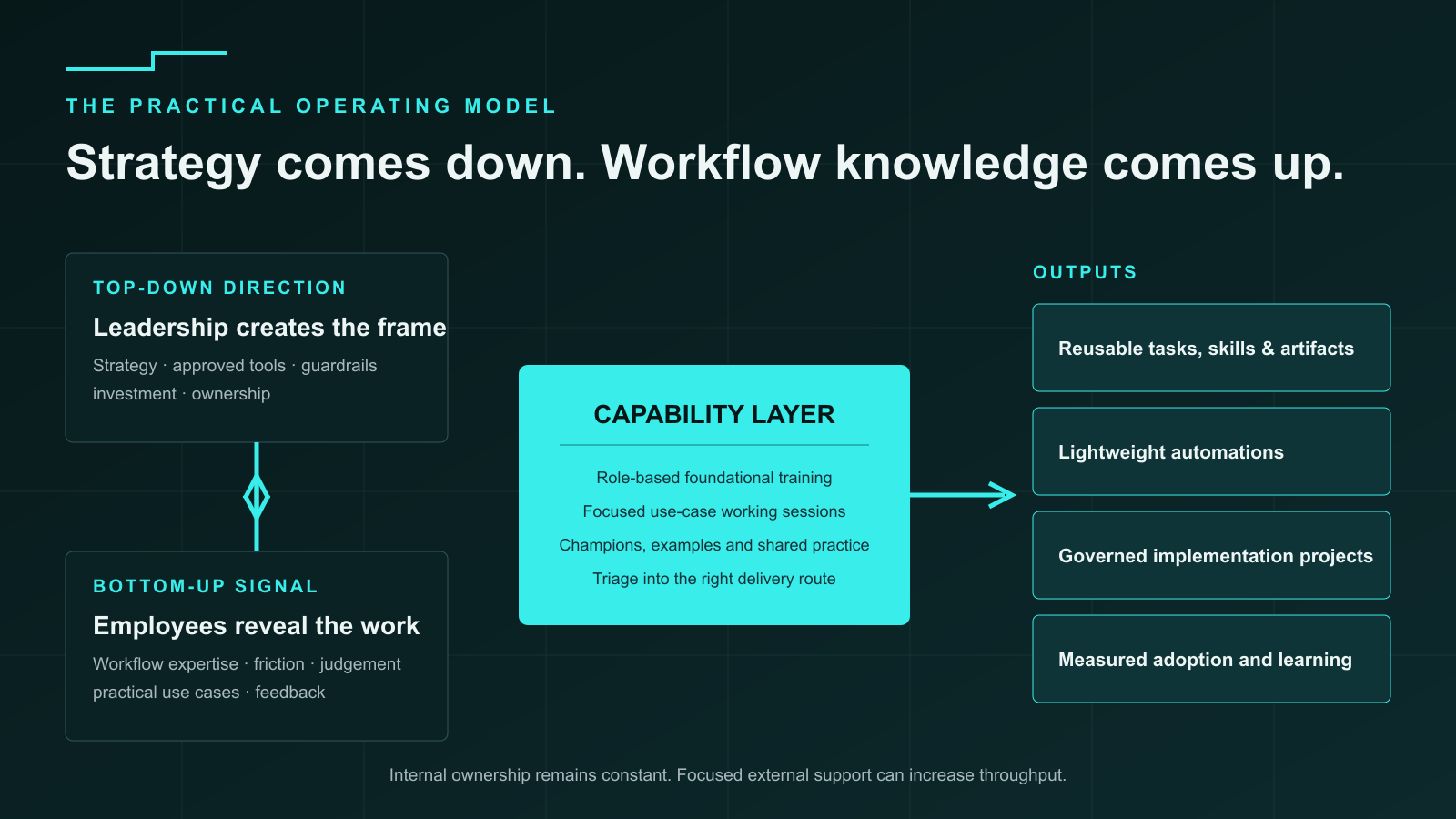
The strongest model combines both:
- leadership provides direction, approved tools, guardrails and investment;
- employees provide workflow knowledge, friction points and practical ideas;
- training and focused working sessions connect the two;
- internal AI teams govern and build the opportunities that need deeper integration;
- champions and shared examples keep capability moving across the firm.
Microsoft's 2026 Work Trend Index describes a similar organisational challenge. Its survey placed only 19% of AI users in a position where individual readiness and organisational capability were both high. Half were still in an "emergent" middle, while other groups had capable individuals blocked by the organisation or organisational capacity that employees had not yet claimed.
That is the next stage of AI adoption.
The top-down push created access. The bottom-up movement is revealing the real work. Foundational training, workflow discovery and a clear route into implementation are what connect the two.
The firms that do this well will not just have more people using AI. They will have more people recognising valuable opportunities, sharing better ways of working and creating a stronger pipeline of automations the organisation can actually implement.
Sources and further reading
- Boston Consulting Group, AI at Work: Why Strategy Matters More Than Tools, 3 June 2026. BCG surveyed close to 12,000 frontline employees, managers and leaders across more than a dozen markets. BCG AI at Work 2026
- Microsoft, 2026 Work Trend Index: Agents, human agency, and the opportunity for every organization, 5 May 2026. The Work Trend Index survey covered 20,000 knowledge workers who use AI across ten markets. Microsoft Work Trend Index 2026
- MSCI, The 2026 MSCI General Partner Survey: The Scaling Imperative, 1 July 2026. The survey of 130 GPs across 12 countries found advanced data, technology and AI capabilities were the largest capability gap cited by respondents. MSCI General Partner Survey 2026
- PwC, M&A: The people problem, 13 February 2026. PwC argues that the binding constraint in AI-driven deal value is whether employees can apply AI to their specific jobs and have the time and incentives to learn. PwC Deals in the Age of AI
- KPMG, Quarterly AI Pulse Survey: Asset Management and Private Equity, 2026. The survey covered more than 100 senior US leaders at large asset-management and private-equity organisations. KPMG AI Pulse Survey