The AI rollout has happened. The training has not.
Most firms have already made AI available. The harder question is whether their people have been given the skills, examples and ongoing support to use it well.
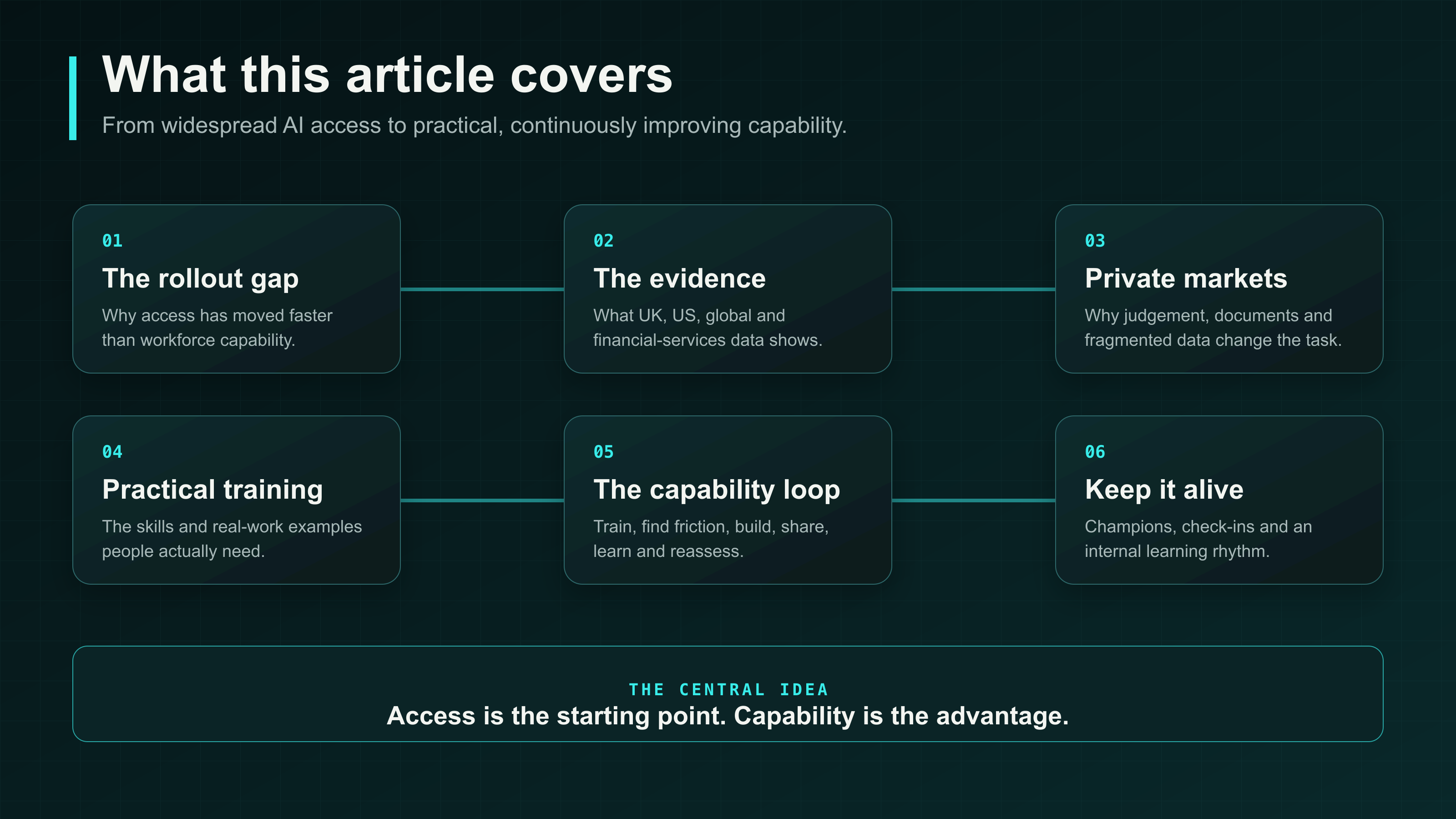
There are two numbers I keep coming back to.
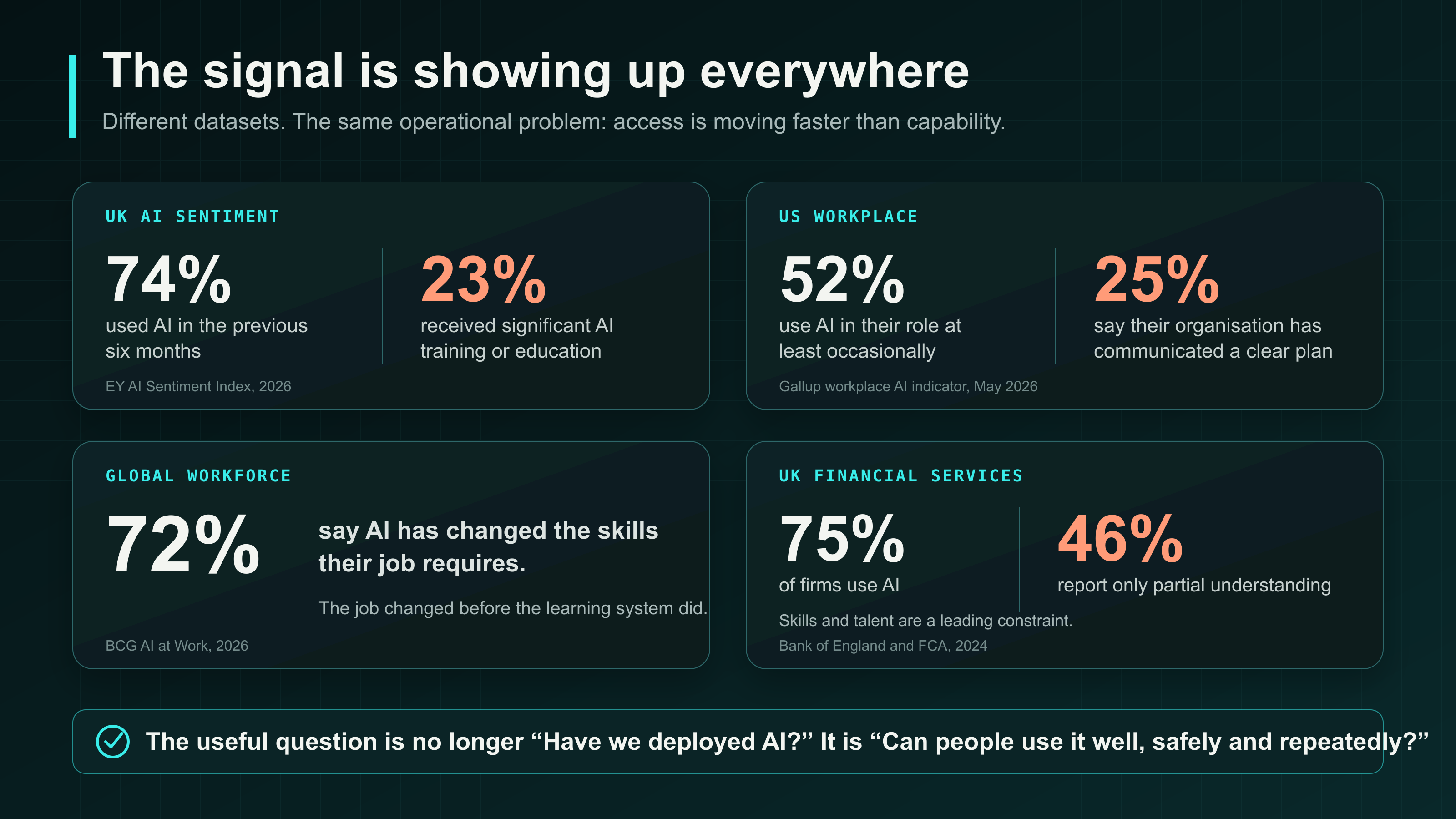
EY's 2026 UK AI Sentiment Index found that 74% of respondents had used AI in the previous six months. Just 23% said they had received significant AI training or education.
Read those numbers together.
AI is already part of people's lives and work. The training has not kept pace.
This was a consumer survey rather than a private-markets workforce study, so I would not pretend it tells us everything about how firms are operating. But the gap it exposes is very recognisable.
Most organisations have bought into the potential of AI. They have rolled out ChatGPT, Copilot, Claude or another enterprise tool. They have created policies. They probably have an AI working group and a handful of pilots underway.
But there is an increasingly obvious problem.
We have rolled out the technology much faster than we have taught people how to use it.
That rollout-versus-training gap is becoming one of the biggest barriers to getting real value from enterprise AI.
This is not just a UK pattern
The same operational signal appears across different datasets without needing to turn this into a country comparison.
In the United States, Gallup reported in 2026 that 52% of employees were using AI in their role at least occasionally. Yet only 25% said their organisation had communicated a clear plan for integrating AI into its work.
Pew Research Center found something similar from the training side. Among US workers who had taken a class or received extra job training in the previous year, only 24% said any of it related to AI.
Globally, BCG's 2026 AI at Work research found that 72% of respondents said AI had changed the skills their job required. In BCG's previous 2025 survey, only 36% of employees said they felt adequately trained in AI use.
The exact questions and samples are different, so these figures should not be mashed into one grand statistic. They do, however, point in the same direction.
The technology has arrived. Organisational capability is still catching up.
The question has changed
A few years ago, the strategic question was:
Should we adopt AI?
There was a genuine first-mover decision. Would you experiment early and build capability, or wait for the technology to mature?
That question is becoming much less interesting.
Most firms have made the decision. AI adoption is rapidly becoming table stakes.
The more useful distinction now is between firms that have AI available and firms that have developed the organisational capability to use it well.
That matters particularly in private markets. The work is document-heavy, judgement-heavy and often spread across data rooms, portfolio reports, investment papers, spreadsheets, email and specialist systems. Simply giving an investment or operations team access to an AI tool does not show them how to use it safely across that environment.
The Bank of England and FCA's 2024 survey of UK financial-services firms makes the point clearly. Seventy-five per cent of surveyed firms were already using AI, yet 46% reported only a partial understanding of the AI technologies they used. Insufficient talent and access to skills was also one of the leading non-regulatory constraints.
Access is not the same as capability.
Foundational AI training needs to be practical
The first requirement is foundational AI training.
People need to understand what the technology can actually do. That means more than learning how to write a slightly better prompt.
They need practical exposure to working with documents, spreadsheets, research, analysis, projects, custom instructions, coding, automation and increasingly agents. They also need to understand verification, confidential data, human review and where the tool should not be used.
Most importantly, the examples need to resemble their actual work.
A private-markets investment professional does not need the same examples as someone in HR. A portfolio team will see different opportunities from investor relations. Legal, compliance, finance and operations will each have their own workflows and quality thresholds.
The objective is not to make everybody an AI expert.
It is to give people enough understanding that, when they encounter a piece of work, they can recognise:
AI could probably help me with this.
That is the beginning of AI literacy for private markets: not memorising features, but recognising where the technology fits into real work and knowing how to apply it responsibly.
AI capability needs continuous maintenance
The second requirement is the one I think many organisations are underestimating.
AI is not software that you implement once and then leave alone.
New models arrive. Existing models improve. Features appear inside tools you have already bought. Connectors make previously inaccessible company data available. Agent capabilities expand. Employees discover new use cases as they become more comfortable with the technology.
A workflow that was not possible six months ago might take ten minutes to build today.
So the firms that get the most value from AI will not simply train employees once. They will build a continuous capability loop:
Train → identify real workflow friction → build → share → learn → reassess tools and data → repeat.
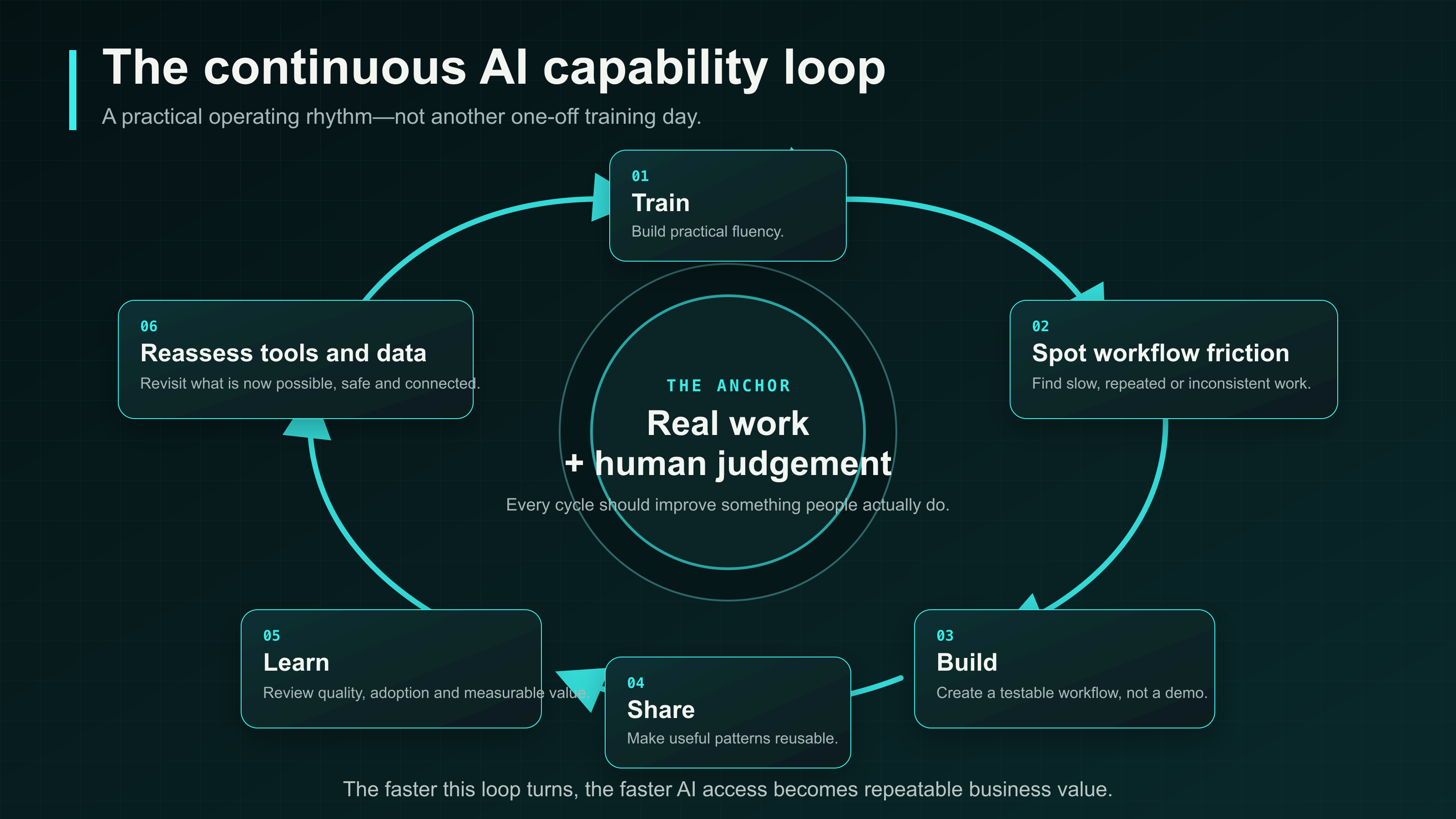
This is what turns AI implementation in private markets from a launch event into an operating rhythm. The broader AI literacy and implementation game plan shows how that loop can fit into an end-to-end programme.
If you need to turn a specific piece of workflow friction into something testable, the 30-minute AI working session is a useful place to start.
This does not need to become another enormous transformation programme
An organisation might bring in a team like Next Step Ventures to run an intensive foundational programme: practical training, departmental use-case sessions and hands-on implementation of the highest-value opportunities.
But the goal should not be permanent dependence on external consultants.
The goal should be to transfer the capability internally.
Create AI champions. Give teams ownership of their use cases. Build a simple process for capturing and prioritising new ideas. Make somebody responsible for monitoring what is becoming possible across the firm's approved tools and data.
Then bring external expertise back in periodically.
For organisations moving quickly, that might be monthly. For others, quarterly may be enough.
The questions at each check-in are simple:
- What has changed in our approved tooling?
- What can we do today that we could not do three months ago?
- What new data can our AI tools access?
- Which use cases are working elsewhere?
- Which existing workflows should we revisit?
- Where should we experiment next?
Even something as lightweight as a monthly update covering new capabilities, good internal use cases and short practical demonstrations can keep the learning loop moving.
Because this technology is moving far too quickly for a training deck created in January to represent best practice in December.
Buying the licence was the easy part
The first phase of enterprise AI was about access.
The next phase is about capability.
The divide will not be between organisations that have AI and organisations that do not. It will be between organisations that simply provide the tools and those that continuously improve their employees' ability to use them.
The winners will not necessarily be the firms spending the most on AI.
They will be the firms that create the fastest learning loop between:
new technology → employees → real work → new use cases → measurable value.
The rollout has already happened.
Now the training, implementation and continuous improvement need to catch up.
Sources and further reading
- EY, UK embraces AI at scale, with trust and governance rising up the agenda, 5 May 2026. The UK sample comprised 1,000 respondents; 74% had used AI in the previous six months and 23% had received significant AI training or education. EY AI Sentiment Index 2026
- Gallup, Artificial Intelligence: Global Indicator, updated 2026. As of May 2026, 52% of US employees used AI in their role at least a few times a year and 25% said their organisation had communicated a clear AI integration plan. Gallup workplace AI indicator
- Pew Research Center, Workers Are More Worried Than Hopeful About Future AI Use in the Workplace, 25 February 2025. Among US workers who had received job training during the previous year, 24% said some of that training related to AI. Pew Research Center
- Boston Consulting Group, AI at Work: Strategy Matters More Than Tools, 3 June 2026. The global survey reported that 72% of respondents said AI had changed the skills required in their job. BCG AI at Work 2026
- Boston Consulting Group, Companies Must Go Beyond AI Adoption to Realize Its Full Potential, 26 June 2025. BCG reported that 36% of employees felt adequately trained in AI use. BCG AI at Work 2025
- Bank of England and Financial Conduct Authority, Artificial intelligence in UK financial services – 2024, 21 November 2024. The survey found that 75% of respondent firms were using AI, 46% reported only partial understanding, and insufficient talent or access to skills was a leading constraint. Bank of England and FCA survey